Grammostola pulchra Brazilian Black Tarantula

Grammostola pulchra, known as the Brazilian Black Tarantula, is prized for its long life, reputation as a docile tarantula, a reduced tendency to kick urticating hairs, and the deep black color of adult specimen.

Wednesday, March 14, 2012

Egg Sac(s), still waiting

Sable(010) has created a depression about 5cm deep and spends a lot of time sitting in it. I am hoping she preparing the depression to lay a sac. She is still eating, and active, but looking huge. Sable(008) has begun to get quite large but has not shown any signs of preparing for a sac.
I am anxiously waiting to see if I made conditions to their liking.

Thursday, February 9, 2012

Sable010 and Ebony008

Still waiting on the girls to decide conditions are good enough to produce egg sacs.

Monday, January 30, 2012

MF G pulchra

Sable, is looking very gravid. If I can keep conditions right she may reward me with an egg sac soon.

Sent via DROID on Verizon Wireless

Sunday, October 23, 2011

New Arrivals and a Loss

I recently acquired some more G pulchra. I added 20 .75" spiderlings, one juvenile female and one adult female. At current I  have 3 adult females, 2 sub-adult females, 2 juvenile females, 2 sub-adult males, and 3 juvenile males, and 20 spiderlings; for a total of 32 G pulchra.
The twenty will be raised in four groups of five each under varying temperature and feeding conditions in an effort to study the effects of temperature and food on growth rates. Group 1 will be fed 3 times weekly and kept at 80F, Group 2 will be fed 1 time weekly and kept at 80F, Group 3 will be fed 1 time weekly and kept at 70F, and Group 4 will be fed 3 times weekly and kept at 70F. All other conditions and environmental factors will be ketp the same for each group. I expect to have viable data within the next 3-5 years.


The Twenty

One of The Twenty

Adult Female, she is due for a molt

Juvenile Female

Onyx(009) the mature male I got from Joe (CAK on Arachnoboards) was sent out recently for a breeding loan. He was paired twice with the female and I told he made good insertions both times. Unfortunately, I was informed that she attacked him after the second pairing and he did not survive the night. I will miss him greatly, he was a beautiful specimen and quite large for a male of the species. Now I wait to see if the female will find conditions favorable to produce an egg sac next spring.
He was also paired with Sable(010) three times, all were very successful, and he was paired with Ebony(008), but she molted out. I was expecting to get him back so Icould air him with her again. I am now searching for another mature male to pair with Ebony(008)


Onyx my mature male G pulchra


Sunday, October 2, 2011

Tarantulas US

Tarantulas US
Excellent forum. Don't miss this one.

Thursday, November 11, 2010

Ebony and Dionysus Paired Up Today

I introduced Dionysus and Ebony(008) today. The pairing went very well, and Ebony made no attempt to chase Dionysus when he disengaged.
Dionysus was placed in the far corner of the enclosure away from Ebony; she was down in her dugout. After a few minutes he got his bearing and slowly made his way around the enclosure to the opposite end of her dugout. He entered the dugout, she approached him, and he ran out as fast as he could. Dionysus stopped at the top of the dugout. Ebony, after a couple minutes, followed him. When she reached him he spun around and it was a flurry of legs until he was able to hook her fangs. He spent five minutes depositing his sperm, then cautiously began to move back. When he felt it was safe to move he ran to the other end of the enclosure and proceeded to try and climb out. Ebony did not chase after him, and just stood motionless for about five minutes. I gathered him up and put him back into his enclosure, where he spent a few minutes at his water dish drinking.Next week Dionysus will pair with Sable(010).
video

Wednesday, September 29, 2010

Dionysus arrived, MM G pulchra

I received a mature male G. pulchra today; thank you Jenn. He was sent to me for the breeding project. He is planned to be paired with Ebony(008). If all goes well, and Ebony is a good mommy, I should have spiderlings by around June of next year.
He is set up in a similar enclosure to Ebony(008), Onyx(009), and Sable(010). A 10 gallon glass tank with about 6" of coconut fiber/pete humus, a water dish in the corner, some silk plants, and a plastic disposable drinking cup with the bottom cut away and a 2" strip cut from the side buried in the corner opposite the water dish.
He has not produced any sperm webs yet, but he has become more active and wanders frequently. Jenn, his previous owner, said he spent much of his time in his hide. So, this is a good sign. As soon as I get confirmation from him that he ready to pair he will be introduced to Ebony(008)
Dionysus' new home, you can see the hide on the left

Top view, the hide is under the silk leaves

Ebony is on the right and Dionysus is on the right


You can see a piece of silk from Ebony(008) I placed in the corner.

Roaming the new home range.

He's a big boy, easily 5.5" (not an easy pose to get)
He's a handsome one

Tuesday, September 28, 2010

The Fab Four Molted (well three of them)

On September 22 both Shadow(003) and Eclipse(001) molted. On September 28 Phantom(002) molted. Shadow and Eclipse were confirmed female, and Phantom confirmed through examination of the exuviums. Now if Midnight would quit being a stage monger, perhaps he will molt soon.
The back story:
When I entered the classroom on  Wednesday, September 22, I went to check on the tarantulas, as I always do, and noticed something very disturbing. I grabbed my stool and stepped up to get a closer look. Eclipse was in the far rear corner of her enclosure in what looked to be a tangled mess. My immediate thought was "Oh no!, She is in a death curl! What happened!" I peered in for a closer look and noticed a few extra legs. *deep sigh* "She is molting." I carefully opened her enclosure, and sure enough she had just completed her molt and was still lying in her back. She had spun a silk hammock over the entrance to her burrow and used it as her molt mat. Thinking she was clear of her exuvium I grabbed my forceps and carefully grasped the exuvium and began to pull it out. Unknown to me, she was still lying on it; as I tugged she flipped over. Fortunately she was not harmed, and I got a perfect exuvium specimen. The exuvium had no tears in at all, and upon closer examination under the microscope I could could see distinct spermathecae. I have prepared her exuvium to be mounted for display.
I went back to the shelf and checked on the other three and found that Shadow has also completed a molt inside her burrow. She looked to have finished her molt a few hours before Eclipse did. Six days later, Phantom joined the group. Eclipse and Phantom have not yet exited their burrows, so I have not been able to get their exuviums out for examination.
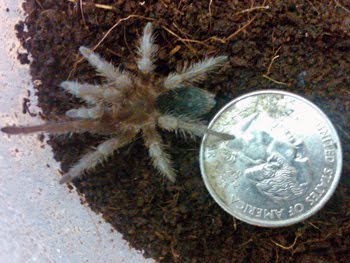
They should all be well over 4" after this molt. This should put the myth about G. pulchra being a slooow grower to rest. I received these four back in December 2009 at just over 1" (they were alittle larger than the diameter as a quarter. Now, nine months later they are over 4". Their molt progression has slowed over the nine months time. In the beginning they were molting about once a month, and now they are molting about every two months. It will be intersting to see how long it will be to the next molt.
Eclipse(001) exuvium is clearly 3.5"+

Eclipse right after the flip

Eclipse, wishing the paparazzi would go away

Phantom's exuvium, nearly 4", if the front leg were extended

Sunday, August 29, 2010

Long Overdue Update

I have reduced my G pulchra numbers from 12 to 9. I sold 012, 007, and 006. I decided since I got the three adults I no longer needed as many spiderlings.  I still have the Fab Four 001, 002, 003, 004 who are all over 3" now after recent molts, 005 who is now 1.25", and 011 who about .5" and preparing to molt again. These young ones will help keep genetic diversity within my breeding group when they mature.
My male, 009 molted recently, but is not yet mature. This turned out to be for the best. My female 008, also recently molted, and my female 010 is badly in need of a molt, so she cannot be paired until she molts. I am apprehensive of her impending molt. Since her age is unknown, she is quite large,and her body is quite worn there is the possibility she is very old.
010  is doing well, and has adjusted to her new habitat. She cast off the broken tibia about a week after arriving. I do not get to see her take prey, but the roaches disappear and her abdomen is plump, so she must eat during the night. She drinks from her water dish frequently, I have caught her in the act a few times now. I do not ever see her outside of her hide, whereas the other two adults are frequently out of their hides.
As a matter of fact, 008 almost never goes into her hide. She sits out on the thick silk mat, in the middle of the enclosure, she spun back in July. 009, the male, will venture out when all is quiet, but bolts for his hide at the slightest disturbance.

The substrate in 008, 009, 010's enclosure had become dry near the bottom (sub is 5" deep) and humidity was about 34%. I added about 1.5L of distilled water to each enclosure over a period of two hours to moisten the lower layers and raise humidity slightly. I use a long funnel pushed into the substrate to direct water to the bottom, keeping the surface dry. None of them has shown any interest or attempts to burrow. They have modified their hides and moved substrate around them, but they do not try to burrow. I am curious to see if they would make a burrow if they had no hide available.

008 9Aug10 solid 6" now
008 9Aug10


009 13Aug10 He is much more stunning than the camera shows. He also covered the glass with silk.

Tuesday, June 22, 2010

Final Adult Arrived

I received the final of the three adults I purchased this summer, a large female, 010. She is from a shipment the seller got from Germany. She is over 6", very brown (due for a molt soon), and suffers from a few breaks to her legs. Two of the breaks look to be older, one looks fresh (probably from shipping). Her abdomen is very plump, and she was quite lethargic unpackaged. I worry she may be a very old female; perhaps too old to breed for the German stock, so she was sold off.
She has a breaks between the tibia and patella on the right pedipalp; between the patella and femur on right leg 2, which appears to have been mended with cornstarch and super glue, this joint is immobile; between the tarsus and metatarsus on right leg 3, the tarsus hangs limp and is not functional, I suspect she will remove it soon; She also has extensive wear of the bristles on the right chelicera, there is a bald patch on the top. If there is enough time before she molts again the damage to her lags might be repaired with the next molt.
After a few hours to settle in she became more active, and responded to external stimulation. She is housed in a set-up similar to 008 and 009.

Friday, June 11, 2010

004Midnight Molted!!!

It has been over three months since his last molt on March 01. I will be examining his exuvium to confirm my earlier examination of male. He is still relaxing from the molt so, I have not been able to measure yet. I am sure he is over 3" now. He never dug a full burrow, he simply dug a pit about 8cm in depth in the corner of his enclosure. When he was ready to molt he spun a hammock over the pit and sat in it to molt. Due to his position he appeared to be sitting upright. he molted without difficulty in this position.

Midnight Sitting in His Hammock Pre-molt


Midnight post-molt

Wednesday, June 9, 2010

Another New Arrival

Today my ~5" male (009) arrived. He was very well packed, and healthy upon arrival. When unpacked he nearly sprang out of his wrappings and ran across the plastic tub used for unpacking and transfers. He developed a small bald spot on his abdomen during transit, but this is nothing to cause concern. He calmed quickly, and was very inquisitive about the new environment. He actively wandered and investigated. He was housed in a similar set-up as the female (008) that arrived yesterday. He is more aprehensive than the 008.
June 11, 2010 update: he has not taken the hide provided. he sits in the far left rear corner just behind the provided hide.


Tuesday, June 8, 2010

New Arrival

I received the first of two sub-adult females today; 5" Grammostola pulchra (008). She is a stunning specimen, and looks to be very healthy. She was housed in a 10 gallon aquarium with about 17cm of coco fiber substrate (15cm moist & packed, with 2cm dry loose on the surface). There are three synthetic plants, cast resin water dish, and a synthetic hide. The plants are for eye appeal, the tarantula probably does not care if they are present or not. The hide provides a place for her to find shelter and security. I chose a synthetic material for the hides to facilitate in keeping the enclosure free of parasites and pests. The resin cast dish, as opposed to a natural stone, was chosen for the same reason.